

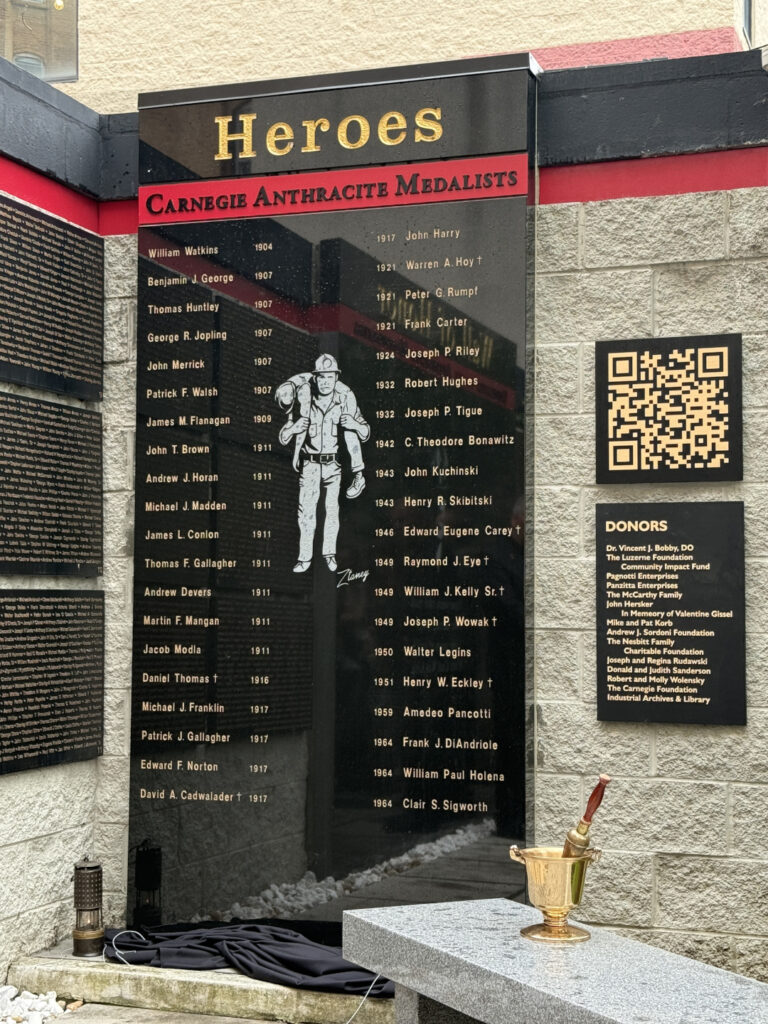
Forty Carnegie Medal recipients whose extraordinary acts of heroism occurred in Pennsylvania’s anthracite coal mines are now honored together on a permanent monument dedicated June 27 at Miners Memorial Park in downtown Wilkes-Barre, Pennsylvania. The monument, created through a partnership between the Anthracite Heritage Foundation, King’s College, and the Carnegie Hero Fund Commission, recognizes miners whose selfless actions saved the lives of fellow workers in one of America’s most dangerous industries.
The black marble monument bears the names of 40 anthracite miners who received the Carnegie Medal between 1904 and 1964 for risking their lives to save others. Their stories span more than six decades of mining history, yet together they tell a consistent story of courage, sacrifice, and an enduring commitment to one another.
The dedication ceremony featured remarks by King’s College President Father Thomas Looney, Wilkes-Barre Mayor George Brown, Anthracite Heritage Foundation co-founder Professor Robert P. Wolensky, the Hero Fund’s Jewels Phraner, and Thomas Lowther Bell, the great-grandson of Carnegie Medal recipient John Tennant Brown, who received the medal after rescuing four fellow miners following a 1911 explosion at Hoyt Shaft near Pittston, Pennsylvania. Following the program, attendees gathered in Miners Memorial Park for the unveiling and blessing of the monument.
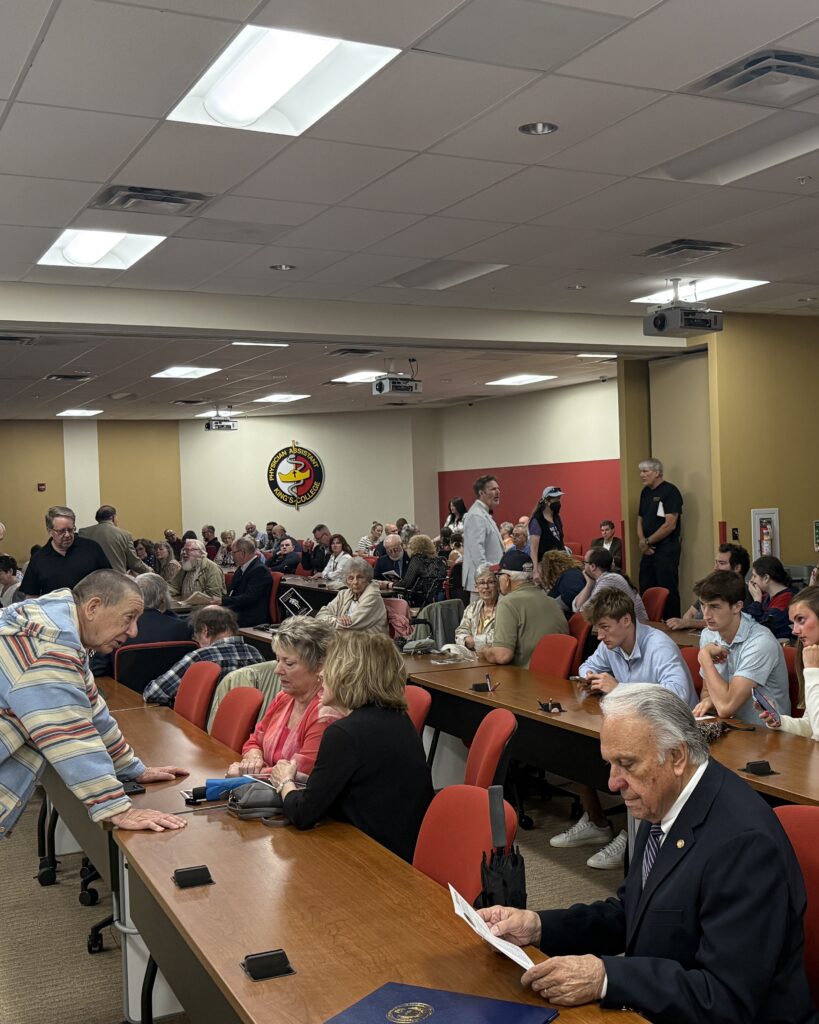
More than half of those in attendance were descendants of the forty Carnegie Medal recipients honored on the monument. Many traveled to witness the dedication and celebrate the legacy of family members whose acts of heroism—some dating back more than a century—continue to be remembered today.
In his remarks, Professor Robert P. Wolensky reflected on the monument’s broader significance, noting that while the anthracite industry shaped the history of northeastern Pennsylvania, the monument honors the individual miners whose courage and selflessness defined its character. He emphasized that preserving their stories ensures future generations remember not only the mines, but the people whose actions reflected the very best of their communities.
In her remarks, Phraner reflected on Andrew Carnegie’s belief that public recognition of civilian heroism serves a purpose beyond honoring individual acts.
“Andrew Carnegie believed that heroism was not merely something to admire, but something from which to learn,” she said. “By recognizing ordinary people who risk their lives for others, he hoped to preserve examples of courage, sacrifice, and service for future generations.”
Phraner also noted that the monument represents more than forty individual acts of heroism.
“This monument is not simply a collection of individual acts,” she said. “It is a record of a community. It is a record of a culture of mutual responsibility that took root throughout the anthracite coal fields and endured across generations.”
Among the men remembered are William Watkins, one of the earliest anthracite Carnegie Medal recipients, who repeatedly entered an explosion-damaged mine in 1904 to rescue trapped workers, and Clair Sigworth, who helped direct rescue efforts following a mine cave-in sixty years later. Though separated by generations, their stories illustrate a remarkable continuity among the miners honored on the monument.
“The technology changed. The mines changed. The generation changed,” Phraner said. “The instinct did not.”
The monument stands adjacent to the Miners Memorial, dedicated in 2014, which commemorates approximately 1,600 miners who lost their lives in the anthracite industry. Together, the memorials honor both the immense human cost of coal mining and the extraordinary acts of heroism that emerged from it.
For many of the families gathered in Wilkes-Barre, the dedication represented far more than the unveiling of a monument. It was the public recognition of fathers, grandfathers, and great-grandfathers whose extraordinary acts of courage continue to inspire more than a century after many of them occurred.
As Andrew Carnegie envisioned when he established the Hero Fund in 1904, the monument ensures that the stories of these forty miner heroes—and the values they represent—will continue to be remembered by generations yet to come.
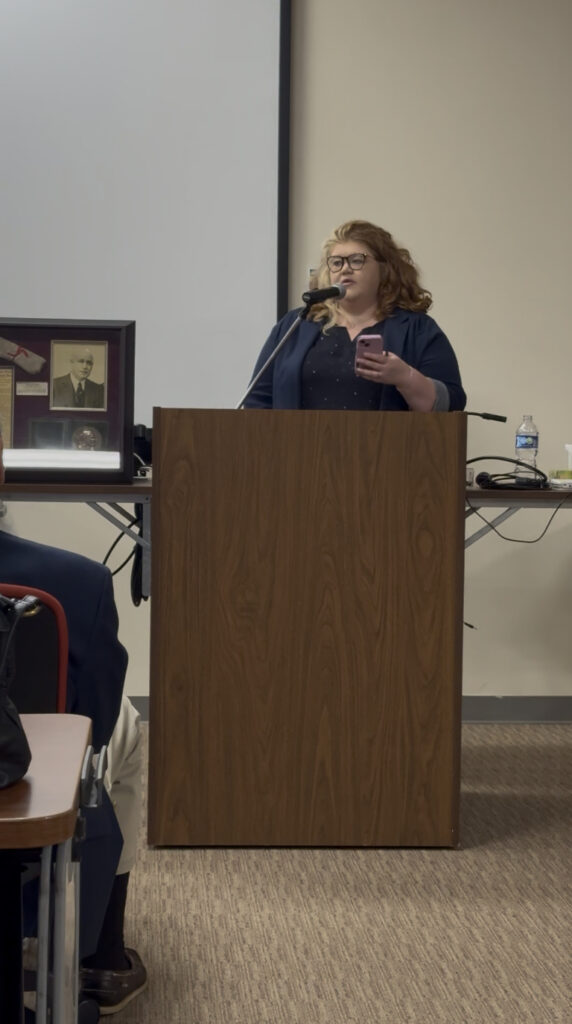
Jewels Phraner, Hero Fund director of administration and external affairs, speaks at the June 27, 2026, dedication at Kings College in Wilkes-Barre, Pennsylvania. “These men are gone. Many of the people they saved are gone. Many of the mines in which they worked are gone as well. Without deliberate acts of remembrance, their stories would disappear with them. This monument prevents that,” Phraner said at the event. “It preserves more than names. It preserves the values those names represent: courage, sacrifice, and the belief that another person’s life is worth risking one’s own. That’s why monuments matter.”
The heroes listed on the monument are:
- William Watkins
- Benjamin J. George
- Thomas Huntley
- George R. Jopling
- John Merrick
- Patrick F. Walsh
- James M. Flanigan
- John T. Brown
- Andrew J. Horan
- Michael J. Madden
- James L. Conlon
- Thomas F. Gallagher
- Andrew Devers
- Martin F. Mangan
- Jacob Modlo
- Daniel Thomas
- Michael J. Franklin
- Patrick J. Gallagher
- Edward F. Norton
- David A. Cadwalader
- John Harry
- Warren A. Hoy
- Peter G. Rumpf
- Frank Carter
- Joseph P. Riley
- Robert Hughes
- Joseph P. Tigue
- C. Theodore Bonawitz
- John Kuchinsky
- Henry R. Skibitski
- Edward Eugene Carey
- Raymond J. Ey
- William J. Kelly
- Joseph P. Wowak
- Walter Legins
- Henry W. Eckley
- Amedeo Pancotti
- Frank J. Di Andriole
- William Paul Holena
- Clair S. Sigworth