
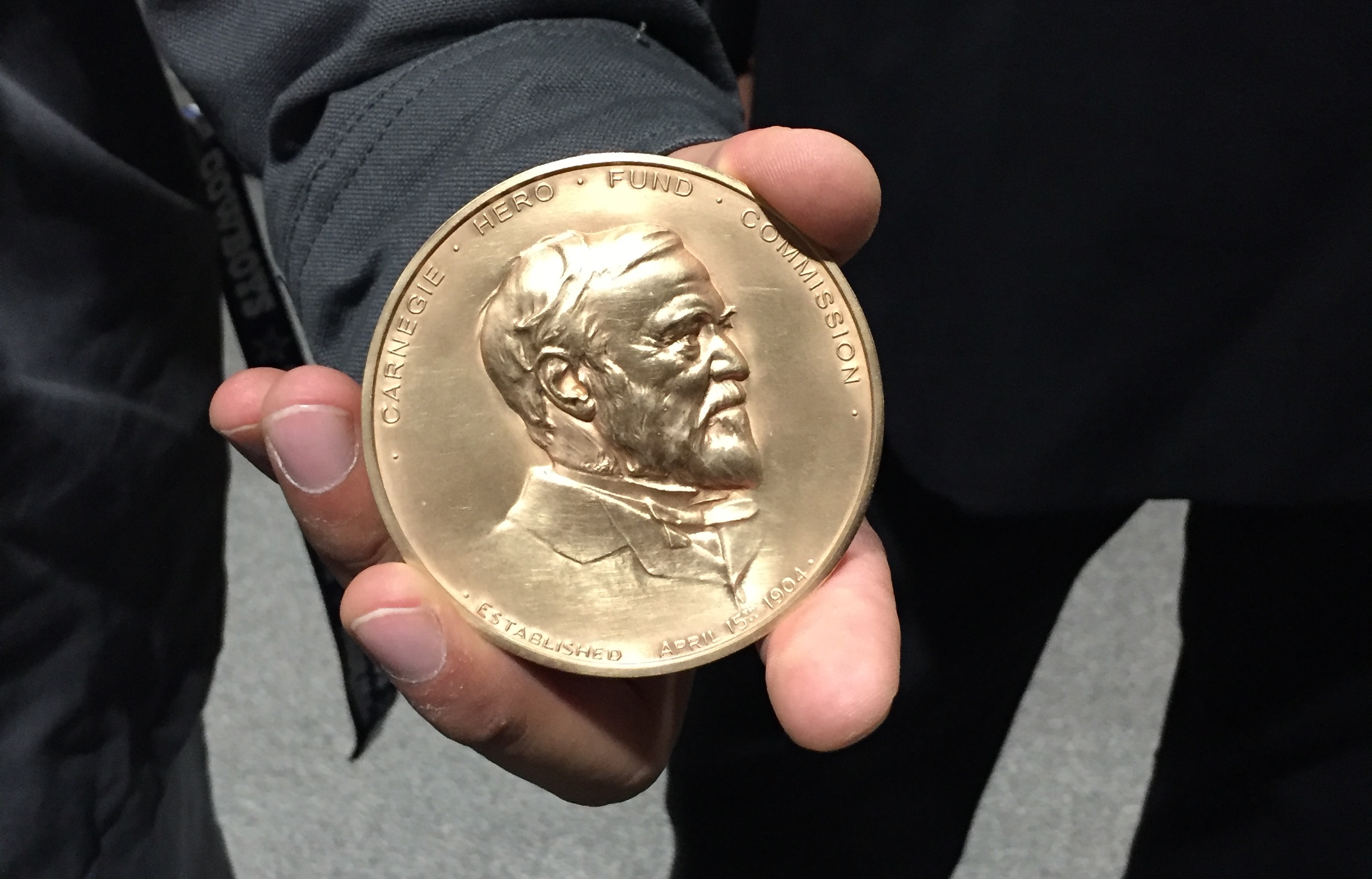
The Carnegie Hero Fund is honored to recognize 18 individuals, including two men, awarded posthumously, who attempted to stop a gunman who opened fire in a crowded bowling alley in Lewiston, Maine, and two men who subdued a knife-wielding assailant who attacked author Salman Rushdie while at a lecture in Chautauqua, New York.
All the Americans recognized today risked serious injury or death, or were killed, saving or attempting to save others in acts of extraordinary heroism. This is the Hero Fund’s third award announcement for 2025. Each individual will receive the Carnegie Medal for Heroism, North America’s highest honor for civilian heroism.
The Carnegie Medal is given throughout the U.S. and Canada to those who enter extreme danger while saving or attempting to save the lives of others. With this announcement, the Carnegie Medal has been awarded to 10,528 individuals since the inception of the Pittsburgh-based Fund in 1904. Each of the recipients or their survivors will receive a financial grant. Throughout the 121 years since the Fund was established by industrialist-philanthropist Andrew Carnegie, more than $45 million has been given in one-time grants, scholarship aid, death benefits, and continuing assistance.
The recipients are:
Nancy Daniel Levittown, Pennsylvania
George W. Greenway IV Sulphur Springs, Texas
Nate Davenport, deceased Jupiter, Florida
Marlin Davenport Jupiter, Florida
Seth Kozak Jupiter, Florida
Mark Robinette, deceased Orient, Ohio
Owen C. Emmons Fort Lauderdale, Florida
KeVaughn Montgomery, deceased Charleston, West Virginia
Jacob Sander Fort Wright, Kentucky
Jonathon Ball Sparta, Kentucky
Matthew Duffiney Cheboygan, Michigan
Jack France Cheboygan, Michigan
Lilly Baker Elkmont, Alabama
Jason Walker, deceased Sabattus, Maine
Michael R. Deslauriers II, deceased Sabattus, Maine
Robert E. Chance Conroe, Texas
Ralph Henry Reese Pittsburgh
Patrick Haskin Hamburg, New York
To nominate someone for the Carnegie Medal, complete an online nomination form at carnegiehero.org or write to the Carnegie Hero Fund Commission, 436 Seventh Ave., Suite 1101, Pittsburgh, PA 15219. More information on the Carnegie Medal and the history of the Carnegie Hero Fund Commission can be found at carnegiehero.org. Follow us on Facebook: facebook.com/carnegiehero, Instagram: @carnegiehero, and Twitter: @carnegie_hero.
On March 16, 2024, 25-year-old Taylor Daniel was inside her family’s one-story home in Levittown, Pennsylvania, when her former partner, 26, arrived with a semi-automatic rifle and was forcing his way inside. About 10 minutes before the break-in, the assailant had killed his stepmother and his 13-year-old sister at another residence. Taylor told her mother, 61-year-old food service worker Nancy Daniel, to hide in her bedroom, while Taylor ushered her two daughters, 5-year-old Aubree Daniel and 3-year-old Arianna Daniel, into the bedroom that she shared with them. With the children hiding under the covers of the bed, the assailant had gained entry and moved into Taylor’s bedroom, where he shot her three times. Hearing silence, Daniel left her bedroom and moved into the kitchen to grab an axe handle that she kept for protection. Rather than fleeing the house, Daniel moved into Taylor’s bedroom and struck the assailant’s head and back with the axe handle. The assailant then turned toward her and repeatedly struck Daniel with the butt of the gun. The attack caused a deep wound to her scalp and cut to her face. The assailant then fled. He was arrested by police hours later. Daniel attempted CPR on Taylor at the instruction of a 911 operator, but Taylor died at the scene. Daniel was treated at a hospital emergency room and received staples to close the largest wound on her scalp. Both girls were physically unharmed.
At night, on Sept. 5, 2024, a 27-year-old woman had fallen from the border fence separating El Paso, Texas, and Mexico into the American Canal. As she was carried downstream, she grabbed hold of a cable that was strung across the canal about 80 feet upstream from the headgates of a wastewater treatment plant, where others had drowned in recent months. State trooper George W. Greenway IV, 45, from Sulphur Springs, Texas, was sitting in his patrol car a mile upstream when he heard the woman scream. Greenway had received a text from his sergeant to be on the lookout for a woman who might have been swept into the canal. He found a border agent who opened the border fence gate for him and soon heard crying behind the fence. Greenway shined his flashlight through the fence and saw the woman in the middle of the canal clinging to the cable. Without hesitation, Greenway moved to help the woman before the border agent could grab a rope bag because he felt she could not hold on much longer. He removed his duty belt, jumped into the canal and used the cable to pull himself hand-over-hand to the woman. Fighting the current, Greenway grabbed the woman with one arm, told the border agent to instruct her to let go, and wrapped his legs around her as she went limp. He grabbed the cable with both hands as he secured the woman between his legs and pulled her toward a steep embankment. Greenway released his grip of the cable and grabbed a rebar step before he hoisted the woman up the step to a level surface. An ambulance soon arrived and took the woman to a hospital. Greenway was not injured.
Nate Davenport, deceased, Marlin Davenport, and Seth Kozak
A 10-year-old boy was playing in an outdoor fountain of a Jupiter, Florida, plaza on Oct. 22, 2023, when he fell facedown and became unresponsive in the water. Authorities later determined that electricity had leaked from several of the fountain’s light fixtures and the boy was electrocuted. While he lay in the water, 8-year-old Marlin Davenport, of Jupiter, who was also playing in the water and was shocked. He was able to alert his sister to the danger, and they both exited the fountain. Marlin and his sister ran toward an outdoor seating area overlooking the fountain to inform their father, Jupiter engineering firm president Nate Davenport, 45, and the boy’s father, sales representative Seth Kozak, 49, also of Jupiter. Davenport ran to the fountain, where he arrived ahead of Kozak, and jumped into the water near the boy. He was immediately shocked and fell unresponsive beside the boy into the water. Kozak entered the water next to aid his son and Davenport, but he was also shocked and became immobilized on his knees. Unable to climb out of the fountain, Kozak called for help. Marlin stood on the splash pad outside of the fountain and grabbed Kozak’s arm but let go when he received a shock through his arm. Again, Marlin grabbed Kozak’s arm and helped Kozak to move his legs out of the fountain, and his body onto the ledge. From there, Kozak lay and pulled his son out of the fountain while being shocked. He began to perform CPR on his son while Marlin stood on the ledge and tried to pull Davenport out of the water. Kozak left his son’s side to return to the ledge, lay chest down, and reached for Davenport while enduring additional shocks as he tried to pull him out. Around the time others joined to help Kozak pull Davenport from the water, a bystander found an emergency shut-off switch and cut off power to the fountain. First-responders arrived at the scene, where they tended to Kozak’s son, who was revived. The boy was taken to a hospital, along with Marlin and his 11-year-old brother, who had entered at one point to try to help. They later recovered from electrocution injuries. Kozak was also treated at a hospital for his extended exposure to the electrified water. His son remained in the hospital for two days before he was released. Davenport could not be revived.
Mark Robinette, deceased
Pastor Mark Robinette, 55; his wife; and four of their children were trapped on the second floor of their two-story home in Orient, Ohio, on Jan. 23, 2024, after a fire had broken out on the first floor and filled the upstairs with dense smoke. Robinette’s son, 14, woke his parents. As fire spread up the stairwell to the second floor, Robinette helped his wife out of a bedroom window. As the 14-year-old moved to run back to his room to retrieve one of his brothers, Robinette told his son that he would go to get “the boys.” Robinette picked up the 14-year-old and pushed him through a bathroom window onto a first-floor roof. As Robinette ran into a hallway, he intercepted his 24-year-old daughter and carried her to his bedroom to push her out through the window. Robinette then disappeared from the window and was not seen after that. He remained inside with his 10-year-old and 17-year-old sons. Robinette was later found in his bedroom. The two boys were found elsewhere in the house. All three had died from smoke inhalation and were badly burned.
A driver lost control of his vehicle after midnight on Dec. 12, 2021, in Newport Beach, California, after reaching speeds of 129 m.p.h. In the passenger seat was 19-year-old Jackson Gutierrez, who was trapped inside the vehicle and rendered immobile after the accident severed his legs at both knees. The driver escaped the car as fire spread within moments along the hood and dashboard. Smoke partially filled the cab and could be seen rising in the air from a distance by Gutierrez’s friend, Owen C. Emmons, an 18-year-old college student from Tempe, Arizona. Emmons arrived at the scene to find smoke and flames issuing from the vehicle he recognized as his friend’s car. He approached the burning vehicle at the open driver’s door and stepped onto the driver’s side floorboard to lean in. Emmons located Gutierrez slumped over the center console amid the smoke and blistering heat. He wrapped his arms in a bear hug around Gutierrez’s torso before he successfully pulled him up and over the center console. Emmons soon realized Gutierrez’s legs had been severed. Backing, Emmons removed him from the car. He carried his friend to safety along the road’s shoulder, where he removed his hoodie and T-shirt to fashion a tourniquet for Gutierrez’s right leg. A bystander approached the duo and used a belt to apply as a tourniquet to Gutierrez’s other leg. Paramedics arrived to take control of the scene and took Gutierrez to the hospital, where he remained for almost two months recovering from bilateral amputation of the legs. He also suffered fractures of the pelvis, arm, and lower back; second- and third-degree burns to the left arm and face; and a traumatic brain injury. Emmons suffered no ill effects.
KeVaughn Montgomery, deceased
An 8-year-old boy slid down a recreational slide on a double-decker pontoon boat into Sutton Lake in Sutton, West Virginia, on July 15, 2024. After entering the water, at a point that was 14 feet deep, he began to panic and struggled to stay afloat. He was wearing a life jacket, but one of the hooks on it unlatched and the jacket started to loosen from his body, but it did not completely come off. The boy’s father, 25-year-old construction worker KeVaughn Montgomery from Charleston, West Virginia, saw his son panic in the water and jumped from the boat. He landed in the water about 10 feet away from the boy and swam to him to grasp him under his arms. Montgomery held him above the water’s surface as the boy panicked, which caused Montgomery to repeatedly submerge. He continued to hold the boy above the surface and eventually pushed the boy a few feet toward the boat. Montgomery then submerged and did not resurface. Other adults in the party had entered the water after Montgomery and brought the boy back onto the boat to safety. The boy was not injured. Poor visibility made it difficult to search for Montgomery and there was no cell service at the scene. Members of the party went to a nearby marina to call 911 and a search was initiated for Montgomery. He was not found until divers recovered his body the following day. He had drowned.
Jacob Sander and Jonathon Ball
Kristin Barbiea, 47, was walking her dogs along a partially ice-covered pond at the center of her apartment complex in Florence, Kentucky, on Jan. 12, when one of them got loose and ran onto the ice. The dog fell into a 30-foot diameter hole in the ice about 100 feet from the bank and Barbiea attempted to retrieve the dog out of fear it would drown. She successfully reached the dog and pulled it up onto the ice, but the ice broke beneath her feet, plunging both her and the dog into the water. She was unable to grasp the edge of the crumbling ice sheet and tried to keep herself and the dog above water. Barbiea struggled for about 10 minutes while calling for help; a neighbor heard her and called 911. On-duty police officer Jacob Sander, 30, from Fort Wright, Kentucky, was in the area and responded to the scene, as did on-duty sheriff’s sergeant Jonathon Ball, 34, from Sparta, Kentucky. Once at the scene, Sander was informed that officers were on their way with rescue ropes, but he later said he felt she might drown if he did not intervene. Sander removed his duty belt and other equipment before stepping onto the ice, breaking through it twice. He located a solid patch before he laid flat on the ice and army-crawled to Barbiea. Once there, Sander grasped her and unsuccessfully attempted to remove her. Meanwhile, Ball arrived at the scene and called out to Sander to ask how he could assist. Fully clothed, Ball made his way out onto the ice while Sander shouted instructions at him on where the ice was most safe. He crawled on his hands and knees about 100 feet to Sander and Barbiea where he grasped Sander by his boot. While Sander pulled on Barbiea and Ball pulled on Sander, the two men pulled her up and onto the ice. Ball and Sander then stood to each grasp one of Barbiea’s arms before dragging her across the ice to shallow water near the bank. Emergency personnel helped them move Barbiea to safety on land and took her to the hospital, where they removed her water-soaked clothing. They provided her with heated blankets. Sander was cold as a result of the rescue but was otherwise unharmed. Ball was cold and fatigued following the incident. He recovered.
Matthew Duffiney and Jack France
On March 10, 73-year-old Charles Grenier was riding a powersports vehicle across thin ice on Black River in Cheboygan, Michigan, when it broke through the ice and sank 13 feet to the bottom of the river. Grenier unbuckled his seat belt and swam to the water’s surface. Once there, he clung to the ice and shouted for help in the frigid water. Property caretaker Matthew Duffiney, 28, of Cheboygan, and his friend, irrigation company vice president Jack France, 28, also of Cheboygan, were ice fishing on the other side of the river when they saw Grenier plunge through the ice. Both men jumped on France’s powersports vehicle and raced over to the man in peril. They parked on thick ice, ran, and then walked, across increasingly thin ice as they approached Grenier. Duffiney crouched down and crawled on the ice to distribute his weight before he reached out to grab Grenier’s hands. The ice soon broke under him and he tumbled into the water head first. France also plunged into the water, and both men then moved to either side of Grenier. They grabbed his arms and tried unsuccessfully to lift him onto the ice. Pushing himself up on the ice, Duffiney spread out on the ice on his belly and pulled Grenier toward him by his arm. Simultaneously, France pushed on Grenier from behind and the two men pulled and pushed until he got onto the ice. Duffiney dragged Grenier to safety on thicker ice while France clawed his way up from the water. All three lay nearly exhausted on the ice, but no one was injured.
At an Ardmore, Tennessee, railroad crossing on Feb. 5, 2024, a 53-year-old woman struggled to walk across a set of train tracks while pushing her wheelchair in front of her. At the same time, a freight train approached at approximately 35 m.p.h., but it could not yet be heard or seen from the scene. High school student Lilly Baker, 18, from Elkmont, Alabama, was driving nearby and stopped to offer the woman a ride. Baker exited her vehicle to move toward the woman, but as she reached her the crossing arms came down, the bells and train horn sounded, and the train continued to rapidly approach. She moved behind the woman, grabbed her under the arms, spun her around, and began to walk backward while dragging her. Baker fell down twice but stood up about halfway to again grab the woman under her arms. She pulled as hard as she could as the two of them fell to the ground beside the tracks as the train passed and hit the woman’s legs. The woman was taken by ambulance to a hospital where she was treated for two broken ankles and severe lacerations on her legs. She recovered. Baker was not injured. The train’s operator indicated that the train came within 18 inches of striking Baker.
Jason Walker, deceased, and Michael R. Deslauriers II, deceased
About 60 people – including 20 children – were inside a Lewiston, Maine, bowling alley on Oct. 25, 2023, when a 40-year-old man armed with an assault rifle entered and opened fire. Within three seconds of entering, the assailant killed an employee at the front counter and began to walk toward one set of crowded bowling lanes. The assailant’s gun jammed about a second after the initial shooting. 51-year-old construction worker Jason Walker and his lifelong friend, network engineer Michael R. Deslauriers II, 51, both from Sabattus, Maine, were with their partners in the bowling lane nearest the entrance. Walker immediately told his wife and Deslauriers’ partner to take cover before both men ran at the assailant, who was attempting to clear the jam with his back to them. Walker was slightly ahead and the assailant turned to face him with his gun raised. Walker leapt into the air in an attempt to kick the gun away, but the assailant managed to clear the jam and shot him in the left knee. He fell to the floor and Deslauriers ran past his friend to rush the assailant with his arms outstretched in an attempt to grab him or the gun. The assailant retreated backwards before he shot Deslauriers twice in the torso. He then moved back toward Walker and shot him three more times, including once fatally in the head. The assailant continued his attack as he moved toward the bowling lanes and killed five more people and wounded three others. He drove to a bar 4 miles away where he killed 10 more people and wounded 10 others. After an extensive manhunt, the assailant was found dead two days later from a self-inflicted gunshot. Walker and Deslauriers were pronounced dead at the bowling alley.
During heavy rainfall in Spring, Texas, on May 28, 2024, 53-year-old Jeffrey Jones attempted to exit a flooded parking lot in poor visibility when he unintentionally drove into a drainage channel. His vehicle was pulled along the channel by fast-moving water before it eventually came to rest atop a submerged pipe and against the dividing column of a concrete culvert. Contractor Robert E. Chance, 38, from Conroe, Texas, was returning to a worksite when he drove over the culvert where Jones was stuck. Seeing Jones inside pounding on the windshield, Chance returned to his vehicle and retrieved a small homemade sledgehammer. He then jumped 2 feet from the road to the rain-slicked hood of the truck. Rushing water was beginning to fill the truck’s bed. Chance attempted to break the windshield with the hammer but was unsuccessful. He then climbed onto the roof and lowered himself into the bed of the truck. From there, Chance indicated to Jones that he was going to break the rear passenger window after he determined the rear windshield would be too small. With one strike of the hammer, Chance shattered the window and Jones climbed into the rear of the truck’s cab, Jones then moved to exit through the opening and placed his right foot on the windowsill. Chance helped steady Jones by leaning over the truck bed’s rail. He extended his right arm through the window opening to assist Jones and then helped him move into the truck’s bed. Both men climbed onto the roof of the truck and onto the hood where a bystander brought a collapsible ladder. They used the ladder to climb from the truck’s hood to safety atop the culvert. Both Jones and Chance suffered no ill effects.
Ralph Henry Reese and Patrick Haskin
During a morning lecture on Aug. 12, 2022, in Chautauqua, New York, Salman Rushdie, 75, was seated on an amphitheater stage preparing to speak at an event when a 24-year-old man, armed with a knife, ran up onto and across the stage and attacked Rushdie. The man stabbed Rushdie repeatedly. Rushdie stood and attempted to flee, but fell to the ground, the assailant leaping on top of him to continue his assault. Responding to the attack immediately was 73-year-old non-profit organization co-founder Ralph Henry Reese, from Pittsburgh, who was seated on stage with Rushdie, and, from backstage, event supervisor Patrick Haskin, 30, of Mayville, New York; and a communications director. The director ran at the assailant and dove, striking the assailant with his shoulder, knocking him off-balance and distracting him briefly. Meanwhile, Reese charged the assailant and held his legs down. At some point, Reese suffered a stab wound above his right eye, and the assailant managed to keep his upper body free to continue his attack on Rushdie. Haskin saw the assailant still had the knife and punched his arm in an unsuccessful attempt to loosen the assailant’s grip of the weapon. Haskin then laid facedown on the assailant’s upper body to hold him down. Rushdie was able to move a few feet away, out of the assailant’s reach, as he lay bleeding on the floor. Others from the audience responded, including a man who sat on the assailant’s back and held down his arm possessing the knife. Someone else managed to remove the knife from the assailant’s grasp and handed it off to someone in the audience area. On-site police and security soon responded to take the assailant into custody. The assailant was found guilty in state court of attempted murder and assault, and was sentenced to 25 years in prison. Rushdie was flown to a hospital for his injuries, including 15 stab wounds, some of which required surgery. One wound blinded his right eye permanently. Reese was taken by ambulance to a hospital, where he was treated for the stab wound above his eye. He recovered. Haskin was not injured.