

By Jewels Phraner, Director of Administration and External Affairs
At a time when public discourse often centers on division and conflict, the collaboration between the Carnegie Hero Fund and the University of Pittsburgh’s data science department is turning attention toward something else entirely: the enduring capacity for human beings to act selflessly.
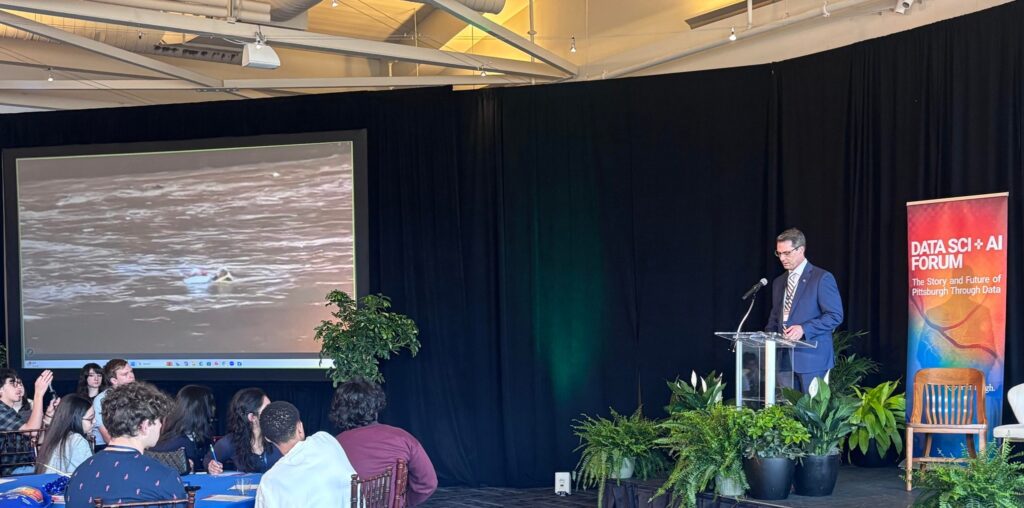
In March, that effort took center stage when Hero Fund President Eric Zahren presented at the University of Pittsburgh’s HAIL (Hub for AI and Data Science Leadership) DataSci + AI Forum, a gathering of researchers, students, and faculty exploring how artificial intelligence can be applied to some of society’s most complex challenges. Zahren’s presentation — and the panel discussion that followed — focused on a question that is both timeless and newly measurable: What can we learn from acts of extraordinary altruism?
For more than a century, the Carnegie Hero Fund has documented civilian heroism across the United States and Canada, awarding the Carnegie Medal to individuals who risk serious injury or death to save others. Behind those awards lies a vast archive: more than 10,000 recognized acts of heroism, along with over 90,000 additional nominations that, while not ultimately awarded, reflect similarly powerful moments of courage, compassion, and moral decision-making.
Until recently, much of that history has remained largely inaccessible — preserved in case files, reports, and narratives that could only be reviewed individually. Now, through a new initiative under the umbrella of the Roddey Altruism Program, the Carnegie HERO (Hero-inspired Education and Research Outreach) Project, allows those records to be digitized and transformed into a structured, searchable dataset for academic research. The goal is not simply preservation, but discovery.
“This is an unprecedented opportunity,” Zahren explained during the forum. “For the first time, enabled by technology and AI-driven tools, we can examine patterns across thousands of real-world decisions — moments where individuals chose to act for the benefit of others, often at great personal risk.”
The implications extend far beyond historical interest. Researchers involved in the project are seeking to better understand the conditions and motivations that lead to prosocial behavior: What factors influence someone to intervene in a dangerous situation? Are there identifiable patterns in how people respond to crisis? And perhaps most compellingly, can those insights be used to encourage more cooperative, compassionate behavior in society?
The forum session highlighted these possibilities. Following Zahren’s presentation, he was joined by a panel of scholars and practitioners, including HAIL Director Michael Colaresi, Drexel University professor emeritus John Clarke, and Pitt data curator Nathan Catlin — in a panel discussion on how responsible data practices and emerging technologies can generate new insights into human behavior. Their conversation emphasized both the promise and the responsibility inherent in this kind of work: using advanced tools not simply to analyze data, but to deepen understanding of the human experience.
Central to the initiative is a commitment to ethical stewardship. The records being digitized often contain sensitive personal details, and the process includes careful review and redaction to ensure privacy while preserving the integrity of each story. The aim is to honor the individuals behind the data while making broader patterns accessible for study.
The scope of the project has also drawn international attention. A multidisciplinary committee of researchers — from fields including psychology, sociology, philosophy, and ethics — has been convened to guide the work. Together, they are helping to shape how this unique dataset can be used to advance knowledge across disciplines.
Yet for all its technical sophistication, the project remains rooted in a simple, enduring idea first articulated by Andrew Carnegie more than a century ago: that through recognizing and understanding acts of heroism, a researchable model of exemplary selflessness can provide a road map to make the world a more peaceful place.
Each case in the archive represents what might be called a “moment of truth” — a split-second decision in which an ordinary person chose to act on behalf of someone else. By examining thousands of these moments collectively, researchers hope to better understand not only what people have done, but what they are capable of doing.
In that sense, the HERO Project is as much about the future as it is about the past. As Zahren noted, “What can we learn? What can be emulated? And what do these moments teach us about the choices we all face?”
Those questions resonated throughout the forum — and they continue to guide the work moving forward.
At a time when technological advancement is often framed in terms of efficiency or disruption, this initiative offers a different perspective: that data and artificial intelligence can also be used to illuminate humanity at its best.
And in doing so, perhaps it will help shape a world that reflects it.
As this work moves forward, the Carnegie Hero Fund Commission remains committed to protecting the privacy and dignity of those whose stories form the foundation of this research. The datasets developed through the Carnegie HERO Project will not include personally identifiable information (PII) not already made public. In addition, all materials are subject to careful review and redaction protocols.
The goal is to preserve the integrity of each act while ensuring that individuals and families are respected throughout the process.
Those with questions or concerns about privacy, data use, or participation are encouraged to contact the Carnegie Hero Fund Commission directly at carnegiehero@carnegiehero.org for more information.